Sunday, February 1, 2015

Hooligan Troupes of the Hither-Fells

When I read this at Monsters and Manuals about the nature of the practice of writing I thought it made sense and so returned to my previous habit of tapping on a keyboard. Nothing came of it at first (there is definitely a rusty period) but eventually the same dense and crusty stuff that I enjoy started to re-emerge, which was gratifying. Additionally, Santicore reared his ugly and I availed myself of the opportunity to do the layout for my own entry which got me interested in the algorithmic approach to content-generation and allowed myself a little bit of sneaky re-writing.

I'm interested in nomenclature and the suggestibility of imaginations. I often approach things from a rather Tolkienesque angle, coming-up with names and then trying to find out what they mean. Rhythm and cadence and prosody as well as connotation and symbolism open up vistas for the imagination to explore.

So I long ago decided that NPC party was insufficiently evocative a springboard for my imagination, suggesting as it did some kind of bland political organisation, so I decided that they would be called Hooligan Troupes. This term was satisfactorily animated and raucous. In my mind they were, of a sudden, alive with agendas and troubles to offer players.

The following table is an attempt I have made to further animate the idea of Hooligan Troupes, as well as engage in a kind of mechanically terse proceduralism. Ideally, the generated troupe will be engaging, memorable and connected to the setting, and the fluff is entirely arbitrary, the tool generates a certain number of characters of a given level, carrying a certain macguffin for a certain patron, pursuing and pursued by other hooligan troupes, specific individuals and factions I have inserted are really just placeholders.

_________________

The Hither-Fells are the rolling wastes and moorlands beyond the village of Foote rolling northward all the way to the rumoured fastness of Gibberhelk, whose dread castellan names himself the Hail-King and gnaws upon his madness in the waylorn wilds. Beyond is unknown and unknowable, a black horizon and interminable twilight.

Gibberhelk, where the Hail-King reigns in procedurally-generated mouldering splendour.


Wandering this vast region are troupes of untamed and exiled wandering villains. To generate a troupe roll 2d6 of different colours: the first roll determines the number of hooligans encountered; a roll of one indicates the leader only is encountered,  roll of two indicates the leader and the lieutenant and so on, it should be noted that an equal number of underlings are encountered as members of the troupe. Additionally, this roll determines the patron for whom the particular troupe is working at that particular time.

The second roll determines the particular troupe encountered with their corresponding underlings as well as determining their grail, this is essentially the macguffin that they happen to be carrying at that time for the patron generated earlier, whether they are delivering it to that patron, taking it from that patron to a third party, destroying it, or doing something else entirely is up to the GM.

There is also an assumed relationship between the troupes: each troupe is assumed to be pursuing the numerically subsequent troupe and, in turn, being pursued by the preceding troupe, all pursuit being with hostile intent (troupe 6, the Strangelings are assumed to be pursuing troupe 1, the Feckless Knaves, creating a vicious circle). Notably, it is possible for multiple troupes to be in opposition and to be working for the same patron, this is merely indicative of the fey and contradictory nature of the powers at large in the Hither-Fells.

Additionally, the second roll determines the level of each individual hooligan within the troupe as per the formula on the table; Leaders are assumed to be 6th level and the lowest ranked member of the troupe is assumed to be 1st level, this can be easily scaled to oppose PC parties if necessary.

Finally, the first roll generates an inter-factional set of relationships that could potentially be exploited for dramatic purposes, while not providing any mechanical effect, the fluff is crunch rule applies.

All of the automatically-generated dials on this array can, of course, be individually generated or determined arbitrarily. It is only my own obsessive desire for elegance and simplicity that makes me do it this way.

The format as presented has a few idiosyncrasies that bear mentioning. It is my preference to, in accordance with the aforementioned desire for simplicity, assume an average number of hit points per level, rounded up and adjusted for constitution. The ability score bonuses and penakties are assumed to be plus or minus one but give the GM leeway,should individual hooligans transition to regulary encountered NPCs, to assign the highest and lowest scores to the appropriate abilities. Armour is given an AC bonus, assuming ascending AC. The curious level titles I have given can act as just another bit of disposable fluff if that is desired, but there is also a secondary, slightly crunchy effect which is that individuals gain a reaction bonus with alike and aligned factions once they've bought into a career, and certain equipment discounts, as well as access to special items can be assumed to be a part of the career's perks. None of this is detailed here so iy can all be safely ignored.


I. FECKLESS KNAVES


     1.       Joachim Crimeshanks: lazy and ­squat, talented dissembler, renegotiates relationships sentence by sentence. [Captain of Charlatans, as thief, INT+, CON-, cranequin arbalest (d8, 1/2), spadroon (d6), buckler (+1), jupon (+1), mail coif (+1)]

    2.       Slatterkin Fraile: seems a freckled ogress in gambeson and kettle hat, betimes dappled light pranks her eyes and she falls and drools and has visions of cool green realms where she is empress [Mosstrooper, as fighter, STR+, WIS-,  halberd (d10), gambeson (+1), Kettle hat (+1)]

3     3.  Hakenbüchse Imbrocato: cunning engineer and strategist, deviser of war-wagons and grenadoes and devices for spraying naphtha and quicklime, he is catastrophically combustible. [Apronman, as thief, DEX+, WIS-,  hand-gonne (d6, ignores armour, 1/3) gunner’s stiletto (d4) grenado (2d8 10’ radius), breastplate (+3) Special: explodes for 3d6 dmg if set alight]
  
     4.       Ginflute Sprig: her jackboots are full of stilettos, her heart is cunning and wary, none who have betrayed her yet live [Miscreant, as thief, WIS+, CHA-,  stiletto (d4) sword breaker (+1, d4), jackboots (+1) pourpoint (+1)]
  
     5.       Crimson Plethora: slatternly, lackadaisical, sinister and pantalooned, there is a reek of sorcery about her, a dusty, musty, fusty smell with redolences of fear and sex, she enthralls monks just to see them grovel and weep [Pythoness, as magic-user, INT+, STR- akinakes (d4), Spells: charm person x2]
   
    6.       Girt-by-Satchels: an utterly abandoned vagrant who compulsively gathers useless things in preparation for an imminent catastrophe, surprisingly dangerous with his clotting-beetle [Vagabond, as thief, clotting-beetle (d6), jack (+1)]


II. LOST CRUSADERS


    1.       Ultrogotha: her hair is enormous, her voice is rich and deep, her destrier is masterful and vast, she wears mirror-bright armour and smells of grease and brimstone [Vindicatrix, as fighter, zweihander (d10), mace (d6), plate (+5), burgonet (+1)]

2.       Amaranth Incarnadine: perilously beautiful and young and lit as if by the last sunset of the world, fleeing the persecutions of her boyhood, the streaming banner of her hair acts as call to crusade [Fugelmaid, as fighter, CHA+, WIS-, arming sword (d8), heater (+2), hauberk (+3)]
   
       3.  Glisterfrigg the Loath: burned black by an encounter with an a laidly wurm, she walks in a shadow of doom with long black spear and black shield unadorned, her mouth is red and her voice is harsh and fell [Shieldmaiden, as fighter, CON+, CHA-, spear (d6) kite shield (+2), lamellar harness (+4)]

    4.       Sledgefork: hooded eyes and splayed toad-hands, pungent flagellant with cassock and flail who flirts with gangrene and arnaldia and sees a ferocious truth behind the world [Flagellant, as cleric, CON+, CHA-, flail (d8), Spells: cure light wounds x2, bless]

    5.       Lammermoor the Infidel: scarified and haunted by the war with the darkness, his hair is white and his eyes are red with weeping, his rusty harness creaks and squeals [Scutiferous Aspirant, as fighter, WIS+, CON-, military fork (d10), half-plate (+4)]

     6.       Hans-who-Itches: has ballestrinos, stirrup-, latchet-, goatsfoot-, cranequin- and windlass arbalests and quarrels for every occasion carried in a barrow-cart painted green and advertising wondrous feats of skill, he is wracked with intense and ceaseless itching so that he is a scabrous insomniac shadow and can no longer shoot. (Arblaster, as fighter, WIS+, DEX-, katzbalger (d6), buckler (+1), Jack-and-chains (+2)]


III. OATHBREAKERS


   1.    Lamgammachy Hallow: ancient crone of viciously sharp features and viciously sharp temper, borne on a palanquin by lurching odiums of mannish shape, claims to be, by hereditary right, Queen of Skinflint Hedge and several gullies thereabouts, demands paltry tribute and vague obeisance. [Gyre-Carlin, as magic-user, w/-  six zombie thralls, WIS+, CON- Spells: magic missile, sleep, invisibility, levitate, lightning bolt]

2.    Hadean Tear: has shorn his head and body and infibulated himself, walks naked in the world bereft of desire, practices daily ritualistic vivisections to retain his purity [Demonologist, as magic-user, WIS+, CHA-, Spells: darkness x2, invisibility, ESP]

    3.    Goatloon, the Carnifex of Untimely Brisket: somewhat bestial giant idiot with a cleft palate and an enormous gleaming axe, prefers to wrastle and bind his victims, gets slobbery with excitement at the prospect of decapitation [Carnifex, as fighter, STR+, INT- , grappling (d2), executioner’s axe (d10, -4 to hit)]

4.    Canterangle Broguentwine: gaunt and studious figure-flinger preoccupied with theoretical deconstructions of reality, is consequently brittle and close to suicide (Figure-flinger, as magic-user, INT+ WIS-, Crutch (d4), Spells: read magic, detect magic, detect evil, phantasmal force]

5.      Chlodovech Harpe: far-wandering warrior of austere and peculiar heathen tribe, cuts his hair in uncouth manner, speaks with clipped and formal directness but incorporating convoluted perversions of syntax and tense, carefully prepares his sica and pelte and individually specialised javelins prior to each battle, kills with workmanlike efficiency [Paynim Reiver, as fighter, STR+, CHA-, sica (d6), javelins (d6), scale corselet (+3), spangenhelm (+1)]

6.    Ariadne Firkinmolde: Fierce huntress with yellow teeth, red coat and blue arrows, rides a jackass all shuddery with malice, has a wild voice for shouting over the wind [Heathen Huntress, as fighter, DEX+, CHA-, hunting bow (d6), sabre (d6),teghily (padded armour), +1]


 IV. DESERT-SEEKERS


1.   The Almondine: denounced heretic false messiah, small and rotund and beaming, she bears the stigmata of unsuccessful crucifixion and of scourgings and rackings but maintains her unshakable certainty. (False Messiah, as cleric, CHA+, STR-,  threshal (d6), gambeson (+1) basinet (+1) Spells: remove fear, resist cold, purify food and water, resist fire, speak with animal, cure disease]

2.      Malthus Pizzlewisp: eunuch-sorcerer, shrill and pasty, elegantly tapered hands and ridiculously superfluous parasol, carries a little cage with a black canary who is intransigent and vile [Castrato Incantare, as magic-user, poniard (d4), Spells: charm person, ventriloquism, mirror image, invisibility, haste ]

3.     Epicanthus Brunt: Braying oaf in knapskull and haberschon who peers from a face that has been ruined by violence. [Brute, as fighter, STR+ CHA-,  morgenstern (d10), haberschon (+3), knapskull (+1)]

 4.  Graylung the Frigantine: sallow youth of vaguely elfin cast and vicious misogyny, speaks in the barely-intelligible affected dialect of the Agnatic Squirarchy, full of circumlocutions and synechdoche and with which even he has difficulty enunciating anything meaningful, wears a crimson coat-of-plates [Gentleprig, as fighter, INT+, CON-, cinquedea (d6) coat-of-plates (+3) heater shield (+2)]

5. Flandleman Rut: apparently moribund toothless gaffer of fiendish vitality, bears a black oar with him in lieu of cudgel to remind all he meets that we paddle through life on a river of misery (Brigand, as fighter,CON+, INT- oar (d6), siege cap (+1) aketon (+1)]

6.   Erasmus Borborygmo: corpulent iatrochemist tattooed with anatomical diagrams relating to the circulation and balance of the humours, prone to radical realignments of personality due to abuse of medicinal elixirs, currently melancholic. (Iatrochemist, as magic-user INT+, CON-, cane (d2), Spell: charm person]


V. EXILES


1.       Tanaquil Slake: Disinherited baroness of a realm that has been burned and depopulated, attired as a cuirassier with three-quarter-plate, cabasset and caliver, insists upon the observation of legal procedure prior to execution and torture, snide [Ignoble Heir, as fighter, WIS+, DEX-, prong-maul (d10), 3/4 plate, (+5)]

2.       Gallivantus Kirklouse: craven Reiter of the Salient Coot who deserted his order on campaign and lives in banishment and disgrace, scraggly ginger beard and unconvincing pale eyes, lance and hammer and munitions harness [Runagate Lancer, as fighter, lance (d10), skullhammer (d6), harness (+5), armet (+1)]

3.       Hackamuggie Lammiger: spade-bearded ark ruffian with wooden leg and boarding pike, outrageously nimble and fearless, chuckles as if at a secret joke (Ark Ruffian, as fighter, DEX+, WIS-, boarding pike (d6), ­­­­­jack (+1)]

4.       Oengus the Cow Leech: Enormously muscular sunburnt cottar of broad-brimmed hat and ugly good-humour, bristling with knives (Bounder-Lout, as fighter, STR+, DEX-, tendle-knife and broacher (d4,d6), buff-coat (+1)]

5.       Forthwith Tobermory the Lesser: Chinless wonder of a hedgepriest-scholar, seethes with discontent, brittle of temper and a secret sadist, hates his greater namesake more than life itself. [Hedgepriest, as cleric, INT+, CON-, quarterstaff (d6), Spell: cure light wounds]

6.       Myriad Burncake: scullion-wench turned cutthroat murderess, exceedingly forgettably plain and mousy, equally deft with razor, garrotte, beaming knife and earshank [Murderess, as Thief, DEX+, CHA-, razor, garrotte, beaming knife or earshank (d4), ringlet-doublet, (+2)]


VI. STRANGELINGS


 1.    Grisly Huberht: Little gluttonous hobthrust with a malevolent profusion of sideburns and a penchant for practical jokes involving terrible mutilation. [Hob o’ the Hurst, as Halfling, CON+, CHA-, War-flail (d8), byrnie, (+3) Shapka – reinforced papier mache cap (+1)]

2.     Nox Nay Nabbity: of apparently indeterminate gender, shrouded in many mantles of fur and silk and velvet finery adorned with broidered sigils and glyphs of ill-omened stars, secretly a Capriped, her bestial features are well hid but her musk is apparent to the discerning nose (Capriped Sorceress, as elf, INT+, CHA-, baselard(d4) kazaghand(+3), Spells: sleep x2, web, phantasmal force]

3.      Frecken Klöster: stunted mummer in grotesque deofol-mask and tintinnabulous coat of bells, dances awkwardly to drive away evil with terrible clangour, is mostly deaf and crawling with vermin. [Hunky-Punk, as halfling, DEX+, INT-, battle-thurible (1d6), coat of bells (+3), special: noise gives +30% to Move silently within 30’]

4.       Gryndercrust: A lubber-fiend, long-armed, cow-tailed, uncouth and hairy. Obsessed with the ritualised transactions of agrarian society, eschews gold in favour of milk and barley, flies into a scything frenzy at the harvest moon. [Lubber-fiend, as halfling, STR+, CHA-, reaping scythe (d8)]

5.      Erstwhile Shale: sharger scout, jogs from hiding place to hiding-place, seeks to outwit, outflank, ambush and murder any possible threat, has barbed arrows tipped with curare and is good with knots. [Sharger, as dwarf, shortbow (d6 + poison), jack (+1)]

6.     Snell the Claker: demon-haunted petty-conjuror of tattered weaselish appearance, has a patchwork cloak of scarlet and green and a hell-fiend’s face upon his arse that whispers appalling things [Claker, as magic-user, INT+, WIS-, poniard (d4) Spell: sleep]
-
______________________________________________________

UNDERLINGS

Underlings are completely interchangeable hapless fodder appropriately themed to accord with the corresponding troupe, one of which appears for each Hooligan present:

AC: 10 MV: 40’ HD: ½ hp: 3 #Att: 1 dmg: 1d4 ML: 8 (10)

1. Wayward Clavigers: servile underlings in faded green doublets and shakos, bearing cluncheons, kirn-crewks, half-pikes and rushlights

2. Lowlander Gaberlunzies: filthy peasantry in sheepskins, bearing sluff spades and dunnuks

3. Children of the Almondine: idiot younglings enthralled by the false revelations of the Almondine, white tunics and righteous wrath

4. Starveling Lampadarii: holy lamp-bearers, gaunt and undernourished, bearing lanterns, candles, torches to light the way and staves to correct transgressors

5. Kithans of Flambergast: scurrilous scoundrels fled from a dead city, sick with grippe, bearing plumbata and caetrata

6. Manikin-folk: poxy midgets half the height of a conventional dwarf, wheedling and sly and bearing nail-swords


Monday, August 4, 2014

Grimmel-Dobbies and Layout

Here's another image from my Middenmurk bestiary. Grimmel-Dobbies comes, as usual, from a couple of dialect words and essentially means Pond-Fairies or Pond-Bogeys, they are essentially my version of the Welsh Gwragedd Annwn. They live in Lake Nenuphar (Nenuphar means water-lilies) and do not remember that they were inundated centuries ago. As far as they are concerned their realm was ever thus and there is no such thing as water. There are stirrings among the feuding houses, though, and a heresy is afoot. What will happen when the Aspidochelone returns? What does the Murmuring Marsgum know? I don't know. I just want to make things as much like a coiled spring as possible. Or like seeds planted in fertile ground or some other tedious metaphor.

Please disregard slight watermark. Depicted individual is a Harpoon Squire. There will be a glossary.
The Dobbies feature in an adventure I am writing but don't have any real job to do save to distract and waylay the protagonists. Actually everything in the adventure is about distraction and sidetracking so I guess maybe they play (or could play) a central role.

___________________________

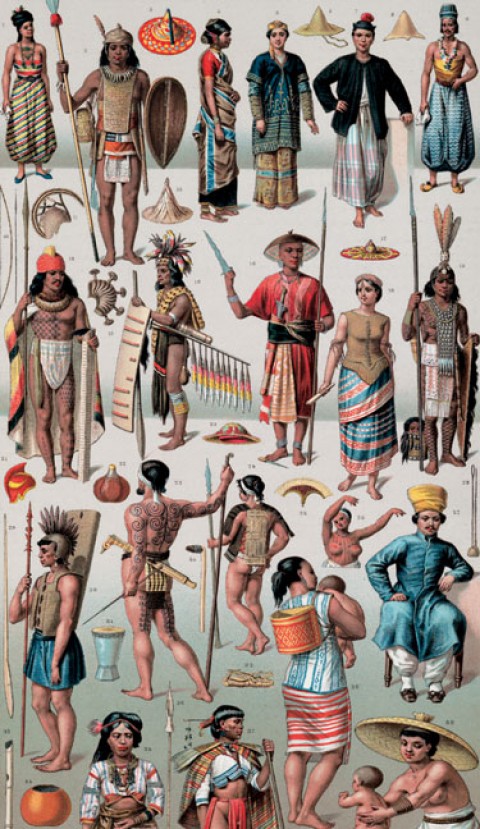
I like layout. I like the way visual information can be unfolded onto a page in such a manner as to produce a thing that rewards prolonged visual scrutiny. Like this from Racinet's Le Costume Historique;

Anyone who doesn't have a copy is missing out. It behooves me to say that several of the reconstructions are bullshit but I've actually developed a penchant for historical apocrypha
There are so many things in this image and in all of Racinet's imagery that you can profitably pore over, that spark imagination, that offer narratives. Admittedly there is a fiendish amount of work involved in this kind of thing but every detail, every bit of fluff offers opportunities. Old Forkbeard there with the red shield has a plume on his helmet that has just got to offer some kind of reaction bonus with other heathens.

See the wickerwork armour with the big backplate shield thing, awesome.
My Taschen copy is in three languages with tiny, tiny text and doesn't explain itself as well as it could but is nonetheless so resonant with ideas and psychic energy it acts as a doorway to endless creative meanderings .

Monday, July 28, 2014

Astragalomantic Ontogeny

I have been playing with layout and proceduralism. There are ways of dragging more information out of every dice roll. Doing this has an aesthetic appeal for me. Every time it is necessary to roll a dice to produce a relatively uninteresting result, like how many of something there are, I want to see more interesting results generated. I am also erring on the side of terse description though I can't see that lasting very long.

This is a mockup and not finalised but contains the kernel of the ideas I am pursuing. The 21 dice icons at the bottom represent a character (3d6 x 6 + starting wealth), every page will have one, the numbers will also be used to determine aspects of the character's destiny and help to facilitate immersive and internally consistent procedural narrative generation in ways that have as yet not been determined.

Astragalomantic parsimony dictates that every roll is laden with consequence. Open in a new tab or you can't see anything;

Astute observers will notice this is a B/X goblin with mild reskinning

Sunday, July 13, 2014

Terrible Weapons

For a very long time I've thought that there was a problem with equipment in D&D. Essentially, a fighter starts with a perfectly decent weapon at the beginning of first level and very soon afterwards acquires the best armour available in the mundane world. By second-level there is not much that interests the fighter on the standard equipment list save more of the same.

I love the idea of having a more comprehensive weaponry-based reward mechanic and also of doing things to generally makes the setting more grubby and/or silly. To do this I am adopting a series of different options which may see initially complicated but will all make sense eventually; bumping up prices on the list, offering more varied gear, having a continuity of options stretching out through the levels and the price ranges and using the "fluff is crunch" principle -that I got from the very clever Roger the GS here, initially, I think.

Price Range: The vanilla price range for weapons is tiny and you can afford whatever you want early on. Using a copper standard it is not incongruous to have poor-quality make-shift weapons available for a handfull of coppers and beautifully made pieces by master artisans available for hundreds or thousands. Justifying this mechanically requires some chicanery but it ain't hard.

Varied Gear: History presents us with a vast range of different tools for inflicting injury. As well as this there is imagination and ingenuity (which I refuse to utilise unless I have exhausted other options). To reflect this variation I offer a series of descriptors with very simple mechanical advantages to apply to weapons. e.g.;

shoddy: breaks on a roll of 1*

hefty: always strikes last unless wielder has a STR of 13 or more

unwieldy: always strikes last regardless

short: always stikes last unless the combatants are grappling in which case always strikes first

long: always  strikes first unless the combatants are grappling in which case is cannot strike

armour-piercing: +1 to hit against medium and heavy armour

articulated: ignores small shields, always hit self on roll of 1

In addition to this kind of thing there will be special stuff like; Many-Tasseled Partizan of Majordomo Braglantore: +1 to morale of nearby Lawful troops, -7 reaction penalty with Castigated Testudines. The Fluff is Crunch principle can be invoked to create advantages/disadvantages as well (and see below). Using such descriptors you can produce a 1 groat weapon that is shoddy, hefty, unwieldy and short and a 10,000 groat weapon that is something tales are told of, all without resorting to sorcery.

Continuity of Options (trickle feeding the goodness): This is important. There is a continuity of options in D&D but the amount of choice/player agency that goes into the processes is insufficient. Magic Weapons are usually the only option after first-level and they are hidden in holes. I don't have anything about magic weapons, I am writing an adventure in which there is a magic weapon but is it overdone ? (Yes) My solution is to have equipment lists beyond first-level - equipment lists are, after all, a reward mechanic. Your bloodstained gold does off you the prospect of advancement but in the short term should also offer you the possibility of more satisfactory tooling up for havoc.

So at the beginning you'll have a few options from the Rabble List, with Kavel-Mells and Dunnuks and Sluff-Spades and everything will be terrible and break constantly so you'll be especially excited about getting enough purloined copper to afford a proper Pigsticker from the Auxiliary List and will trek across dangerous territory to buy something that doesnae always break. After this come the Elite, Splendiferous and Ludicrous lists etc.

Fluff is Crunch: a gavelock may well be heavy and unwieldy but it is still an iron crowbar which could be used for leverage and breaking stuff, a draige is attached to a big piece o' chain which has many purposes, a clotting beetle used for breaking sods in the field could be argued to convey some advantage against the Sinister Sod of Metheglin Meugle. I like that most of the things in the equipment table have no mechanical description but are merely plot tokens to be negotiated with the GM on a case-by-case basis.


The Rabble List

1. Yowing Knife: the tool with which slates are trimmed - d4, shoddy, unwieldy. 5 groats
2. Cruke: shepherd's crook - d4, long, shoddy, 3 groats
3. Clotting beetle: a long handled hammer for breaking clods in the field - d6, hefty, shoddy, 10 groats
4. Maddock-hoe: a digging tool, a mattock - d6, hefty, unwieldy, 7 groats
5. Barnet: a cart whip - d2, articulated, long, 12 groats
6. Threshal: threshing flail - d6, articulated, unwieldy, 10 groats
7. Brummock: short curved knife for hedging - d4, short, shoddy, 4 groats
8. Fourgeon: wooden fork - d4, shoddy, 5 groats
9. Hod: spatulate trowel for wrangling mortar- d4, short, shoddy, 5 groats
10. Snathing Axe: small axe for snathing - d6, short, shoddy, 8 groats
11. Huggie-staff: staff with iron hook for fish, d6, long, unwieldy, 7 groats
12. Kent: spiked staff used by shepherds for leaping ditches - d4, long, shoddy, 1 groat
13. Muckrake: for raking muck - d6, shoddy, unwieldy,  6 groats
14. Battledore: a flat wooden paddle instrument used as a mangle substitute - d4, shoddy, 3 groats
15. Kavel-Mell: sledge-hammer for breaking stones - d8, heftyunwieldy, 15 groats
16. Sluff Spade: wooden spade with metal-reinforced blade - d6, hefty, shoddy, unwieldy, 5 groats
17. Hack-hook: curved hook with a long handle for hedging: - d8, long, shoddy, 12 groats
18. Cluncheon: a cudgel - d4
19. Flesh-axe: cleaver, d6, short, shoddy, 8 groats
20. Tendle Knife: a knife for cutting firewood or turf like a billhook - d4, shoddy, groats
21. Oxter-staff: a wooden crutch - d4, shoddy, 2 groats
22. Drowning Knife: large blade on a pole for cutting ditches - d8, unwieldy, shoddy, 20 groats
23. Meathook: a meathook - d4, short, 3 groats
24. Klot: A hoe used to scrape up mud - d6, unwieldy, shoddy, 7 groats
25. Beaming Knife: tanner's knife - d3, short, 4 groats
26. Prong Spade. digging fork with three thick prongs - d6, unwieldy, shoddy, 10 groats
27. Draige: iron hook on a chain for pulling down burning thatch - d6, articulated, unwieldy, 12 groats
28. Dunnuk: dung fork - d6, unwieldy, shoddy, 15 groats
29. Clip-shires: iron shears - d3, short, shoddy, 12 groats
30. Gleavie: barbed eel spear - d6, shoddy, 13 groats
31. Gavelock: iron crowbar - d6 hefty, unwieldy, 15 groats
32. Mash-mungle: an instrument used in brewing to stir the malt - d4, shoddy, 1 groats
33. Lang-saw: a saw - d4, shoddy, unwieldy, 18 groats
34. Grafe-hook: sickle - d4, short, shoddy, 5 groats
35. Broacher: A very large, sharp-pointed knife - d6, shoddy, 10 groats
36. Brand: a flaming torch - d4, on fire, 1 groat

* It should perhaps be noted that I am aware stuff didn't break so frequently in real life but I am concerned with genre emulation here. It is, after all, the Dung Ages.

It occurs to me that I'd like to use a perverse version of the Chekhov's Gun principle to incorporate procedural world-building into the initial character creation phase (more on this another time maybe) such that purchasing a sluff spade precipitates events into reality such that you might have to save a peasant family from the aftermath of a bonnacon's fecal onslaught or purchasing a battledore generates a spectral Washer-at-the-Ford who needs help with laundering the clothes of those she loved and slew. Such fairytale nonsense appeals to me but these "weapons" are so useful they probably don't need such stuff.

Edit: My old post on using a copper standard is of relevance here.

Sunday, June 22, 2014

The Affairs of Wizards

I am not interested in 5E because it is inextricably linked to the contemporary fantasy aesthetic. This also happens to be the secondary reason why I hated the Hobbit films. I realise I have exiled myself to a barren peninsula of my own eccentricity here but the fact remains that the aesthetic essence of the thing (i.e. its "style") matters far more to me that playability, accessibility or innovation. If 5E pursued a Weird aesthetic and rolled out Ian Miller, Russ Nicholson and John Blanche to illustrate it I'd be sold, no matter what goofy mechanics it might have.

Conversely, Oleg Denysenko, Denis Forkas Kostromitin and Vania Zouraliov could do it. Contemporary Russian illustrators are bloody marvelous.


I know the world shall continue to recede from the ideal I carry in my head. It matters not.

-----------------------------------------------
So D&D magic is decidedly not magical. This galls me. There is such potential for intriguing and evocative as well as conducive to the initiation of self-perpetuating action-in-the-game-world stuff in magic but I don't see it used much.

Firstly and importantly, given my long-time obsession with reward mechanics, I believe that neglecting to foreground the accumulation of spells as an important part of the magic-user's progression is missing out on part of the fun of playing that role. If a magic-user has no particular relationship with their spellbook and no motivating desire to go forth and pilfer the spellbooks of others for mystick puissance and abominable mysteries then they are functionally, in terms of relationship to the campaign setting, not so much differentiated from the other character classes.

Of course the universal focus of the bloodstained gold reward system is valuable for tying together the party's major pursuit (plunder) but there is a beauty in individually differentiated class rewards. Magic items offer this to an extent, creating a dynamic where there is an understanding that beyond the typically slow and linear creep up through the levels there will be little bonuses here and there that will create sudden flashes and leaps of extra power, magic swords and wands and rings and the like, which constitute an extra, parallel reward system. In addition to this there is another, similarly underdeveloped reward system composed of more mundane items, purchasables like hirelings and retainers and ships and castles. All are means of augmenting agency within the gameworld and all are awarded by the GM to PCs whose actions have been sufficiently entertainingly ingenious and intrepid.

-As an aside there is another intriguingly under-investigated social-aesthetic dynamic that goes on where the GM invests a portion of their effort and pride and love and care into the setting as an aesthetic object and the players petition with their interest and their care to be allowed to have agency within the gameworld. It is only through being an exceptionally good audience to and collaborators with the performative efforts of the GM that the secrets of the world reveal themselves and it is only through playing along with this fantasy, making at least the appearance of being enthralled by the GM's aesthetic virtuosity that the greatest secrets are uncovered. There is a thing about hospitality and flattery and communal aesthetic experience here that I shan't be pursuing further. Suffice to say: listen well and play along and ye shall be rewarded-

Carcosa has a very interesting and deeply integrated-and-conducive-to-action magic system. I refuse to believe that there was never any intent that the players were never supposed to be sorcerors. While I acknowledge that the rituals involving the raping and murdering of children are too abhorrent for people to enjoy playing out and are actually much more effective as means of defining who the bad guys are and defining what the hitherto evocatively defined as unspeakably blasphemous rites actually consist of, the fact that the magic system and hexcrawl are so interlinked is brilliant. The map is fairly festering with Macguffins. Aside from the obvious unpleasantnesses, playing a sorceror in Carcosa would be cool, you've got places to go and people to see from the get go. Additionally, assuming the antagonists are probably sorcerors, they've got things to do also. Given a little inside knowledge it becomes obvious that the sorceror or his minions are trying to get the Radioactive Purple Crystal from Hex 0121 to the Seething Chasm of Indeterminate Depth in Hex 9982  to summon the Quaking Eidolon of Thrausaath-Glybbe (or whatever) and there you have a clear set of objectives and something to do while sitting around the table with your friends.

__________________________________

So, in this conception, magic spells are unlocked from the mysterious cosmos by the performance of particular rites. This gives the initiate access to the arcane mysteries which may then be inscribed in their grimoire and "memorised" daily, as normal. The written version is essentially enchanted, it functions as a magical scroll and may be destructively invoked in a similar manner, over and above its normal spellbook function. Once a spell is thus lost from the grimoire it is necessary to go through the whole process of ritual to regain the spell. Spells stolen from other magic-users may (after unlocking with Read Magic) be "burnt" as scrolls, additionally all written versions of spells of necessity contain the instructions for performance of the rite that unlocks the mystery.

The individual spells in the magic user spell list are divided between a number of different factions in the setting (with a considerable degree of overlap). Each jealously guards its secrets and the rites that allow their revelation. It is only possible to achieve the ability to cast every spell by begging, borrowing or stealing from a number of different sources.

Finally, language is the key to unlocking the knowledge, many languages within the setting have an association with a particular set of mysteries, knowing the language means knowing the mysteries. The languages and their associated magical disciplines are as follows;

Five Paths of Lesser Sorcery

1. Elder Druideacht - Language of Birds
2. Bastard Alchemy- Alchemists' Cant
3. Lowlander Spae-craft - Meagre Tongue (i.e. "Common")
4. Mantic Disciplines of the Old Imperium - Diviners' Cipher
5. Heathenish Witchery - Heathen Tongue
-----------------------------------------------
Exempli Gratia: Elder Druideacht

The degraded rites of Low Druidry are relicts of the blasphemies of the north. The fell Druideacht of the northern heathens bound together their tribes in ties of blood and law and sacrifice. Theirs was an elder pact with the powers of the wicked earth personified in primordial gods of field and fen and unquiet ancestors craving sacrifice from the darkness beyond.

There are six first level spells in the druidry spell list, a beginning initiate will have already performed three of the rites but will know the rites to access the others

-The Willing Sacrifice (Charm Person) A pristine entity (white calf with red ears,  blind foal, seven-day-old kid born in the new moon's dark)  is bathed in milk and crowned with a wreath of mistletoe cut with a silver sickle. Songs are sung over it of Ancient Law. Eating of its heart will reveal the mystery

-Ordeal of the Hodimadod (Detect Magic) At one of the known junctions of cosmic alignment between nexi of the embodiment of ancient lore (henges, raths, cromlech-graves, sacred groves and pools) the initiate must spend the night alone in a circle of seven knives and ritualistically strangle themselves seven times with a rope of their own hair that they swoon and fall. In the half-world between oblivion and wakefulness the mystery will be glimpsed.

-Walk Untouchable (Protection from Evil) All sprinkled with gold dust, glimmering naked and drunk on tainted mead, the initiate must enter the opened tomb of a hallowed ancestor and lay together upon the slab, eat of its fingernails and hair and plead and beg the answer to the riddles of death and life .

- Assimilation of Ink (Read Languages) From the mingled blood of a dozen initiates and the gall of a blasted oak and the venom of a murtherous humbledrum an ink must be brewed and the flayed skin of an ancient scholar adorned with the ciphered runes and the hundred forms of ogam and all the abecedaries of the Old Imperium and glyphs and ancient scripts forgotten by time. This skin must be slowly eaten and the initiate stricken with the poison for seven nights.  On the eighth day the initiate rises with ink in their veins.

- Vigil of the Grey Horizon (Sleep) The initiate undergoes mystical incubation wrapped in the flayed hide of a walrus, nettle-crowned and covered in bone-soot. The initiate must hold wakeful vigil for seven nights upon a shore between earth and restless ocean until oblivion beckons in the voice of a gull. In that voice can be heard the mystery.

-Blinding the Cipher  (Read Magic) Skyclad and fasted upon the dawn of Midsummer's Day the initiate must gaze into the rising sun until the world goes out of their eyes . Thereafter, they are led into a grove where ogam-staves and runestones and grimoires of mystick writings are kept and made to look upon them as their sight returns. In the dim light of returning vision the secret will glimmer among the glyphs.

et cetera

--------------------------------------
As the character progresses through the levels it will become necessary to collude with other magicians to perform the rites necessary to unlock new forms of magical power. The different paths will have entirely different ways of gaining access to essentially the same spell - spae-wives  will brew philtres of love to gain the ability to charm (instead of eating the heart of an innocent sacrifice) and other paths will pursue other means. In addition to this there is always the possibility that some kind of fraternisation with elves might be possible (though unwise).

Saturday, February 22, 2014

Howling Across the Chasm

When the time comes for describing the monster the GM looks up and to the left, searching for the words,  and the hands come out and begin delineating and caressing the invisible contours of this thing they are imagining. The players are transported, to some extent, by this performative enactment of monstrosity. It is not merely the actual description of the monster but the struggle for description that bears the aesthetic reward. There is a moment of shared mythopoieia where the GM is delving in their visual imagination and the players are doing the same and the fruit of that description, the mental image and conception of the thing is born in everyone's mind, fresh and immediate and consensually realised. Then the players take that emergent image of the monster and embed it in the situation they find themselves in and it becomes a threat or an opportunity, a mystery or an unmitigated calamity unfolding.

That such a thing can occur at all in the context of aesthetically mediated group-bonding rituals is wonderful to me. That it occurs all the time, as a matter of course is even more so. The storytelling instinct and the competitive instinct and the yearning for group one-heartedness humans possess innately makes this miracle commonplace, to be taken for granted. 

There are two distinct kinds of excitement I am interested in that can arise from the moment of description. The first of these is the dawning familiarity/dread response: "You see a wrinkled sphere hanging in the gloom atop which writhe a number of short tentacles and from the midst of which there glares a single baleful..." "Fuck, Beholder! Run!" The second is the unfolding mystery response which makes me think of my own first D&D session - I encountered a rust monster and a carrion crawler, neither of which I had any notion of beforehand and both of which made a very strong impression on me such that subsequent encounters engendered in me the dread response, the thrill of which was all the keener from the disastrous initial meetings.

I am a bit jaded about settings and scenarios that only use established, folklorically entrenched D&D beasties. There is an OSR tradition of using such creatures in novel combinations and in new ways which is laudable but not what I am chasing here. There is also the accumulated technical knowledge of ways and means of dealing with monsters that brings with it a certain kind of slick satisfaction - even if that satisfaction is derived from huddling in a grimy corner trying to bless the last crossbow bolt before the rakshasa finds you and provides a tragic finale to your travails. These things have their own particular aesthetic appeal but I would like to investigate other ways.

The other way I have always striven to pursue is to try to reboot the process. To begin anew with whatever descriptive powers I can muster to break through to the freshness of things as-yet-unimagined. From whence will inevitably commence the diminishment of novelty. If it can be engineered that this slow death of wonder can be made to pass through phases of notoriety or fond familiarity then all the better. 

_____________________________________________________________


Foreshadowing

In published scenarios it is not uncommon for there to be examples of the literary device of foreshadowing. Rumours and portents precede the thing towards which the PCs are being guiltily ushered (often in direct contravention of accepted orthodoxies regarding railroading). Conversely, wandering monsters are almost never foreshadowed save as plausible inhabitants of certain habitats. If you go traipsing through the Accursed Principality of the Dead and encounter Spindle-Ghaists tripping bonily along the very nature of the place has done the work of priming the players' expectations for something gaunt and necrophilous, but there is scope for introducing other means of telegraphing intention to ramp up dread. Wandering monsters are usually just there, a sudden unpleasantness to add artful disarray to a situation that was probably going terribly awry in the first place.

So, as a means of fleshing-out the environments through which the PCs travel and of producing a sense of foreboding it would be aesthetically pleasing to have signs that precede the appearance of wandering monsters. Something like;

Dost thou wander the Lackly Veil? Roll each morning and evening upon this table;

1. Reek of burning hangs in the air and trees bear jagged wounds. Distant screams as of animals in pain. (Ugsome Boors)
2. Cruel honking geese harry and harrass, following at a distance, regarding with sinister sidelong glances or darting in to bite. (Aglæcwif)
3.The land about seems suddenly gaunt, pinched and harrowed as with years of hunger. Something rumbles from afar. (Grunzel-gullet)
4. Twittering starlings shrill and flock, innumerably multifarious, surging and warping on the northern wind. (Sceadugenga)
5. Huge footprints as of some elephantine behemoth have torn the countryside. Morning fog lasts too long. (Pukelin Tark)
6. In a mournful quiet, sparse and wiry grass grows in old lime-pits and red clover nodding in the breeze. (Marlebrute)

etc. 

Following such a foreshadowing and assuming something in the manner of an onward trajectory or feckless tarrying (rather than immediate withdrawal and/or other countermeasures) there is a 50% chance that the next wandering beastie corresponds to the foreshadowing (or if multiple things have been foreshadowed 25% or 16.7% or 12.5% each or whatever). The aesthetic intent here is the establishment of linkages, of apparent depth in an essentially procedural reality where depth can be hard to come by. 

I dislike the idea of determinism and the removal of agency but keenly love doom and foreboding. It would be nice to have the PCs discussing intently whether to go on up the Worm-Road knowing they'll probably meet the Pukelin Tark that tore out Pieter's lungs or go back around the hills where the starlings flock and risk forgetting their own names.
_______________________________________________________________

So there's this thing:

Monster Reaction Table 

Roll Result 

2 Friendly, helpful                        
3-5 Indifferent, uninterested 
6-8 Neutral, uncertain                  
9-11 Unfriendly, may attack 
12 Hostile, attacks                       

The reaction table is the vastly underused social mechanic I tended not to use. I saw it as an excuse to skip past the important funny voices component of the game. I now see it as an armature upon which vast quantities of setting-specific colour can be hung, fluff crunchified, fashionable curly shoes and ruffs and virtuosic sackbut performances rescued from obsolescence.

More on that later (or maybe never if you're lucky). It suffices to say now entities have a hostility rating, ranging from -9 (St. Cumbertwilde on her Sanguine Ass) to +17 (Vehement Rutabagas). PCs can have some effect on this with gentle croonings or bribes of food etc. but the general rule is that different things exhibit different behaviours. I recall the thing of most interest to me in the crowd-sourced Grognardian endeavour - Petty Gods - was the concept of individualised reaction tables. Reaction need not be a consistent spectrum but a set of behaviours specific to the behaver and modified by affordances particular to its predilections.

_________________________________________________________________

So that the discerning GM may interlard their nattering with a few choice phrases without resorting to the stultifying tedium of boxed text I have chosen to give descriptions of these beasties in collections of fragments. Of course, the danger that the fragments themselves may infect said GMs' tones with the recitative droning inflection typically derived from reading shit out may be circumvented through judicious insertion of an implied et cetera after the suggested phrases and the use of (hopefully pre-sparked) imagination. There are plenty of details in these fragments conducive to dramatic description.

For a while it's been floating in my head as an alternative approach to the verbose gibberish I usually employ but Jacob Hurst's Dire Boar Den Information Layout Thingy has encouraged me to experiment.

- Also, no more descending armour class. I relinquish orthodoxies reluctantly but recognise finally that I'll be able to maintain the mechanical parsimony I desire at the same time as not doing that little mental calculation every time. It isn't an enormous effort but any means of doing away with unnecessaries appeals to me.


Pilshach Oobit                                                       
Brutish Earth Sprites


Foreshadowings:

Moldiwarps emerge from their diggings to sneer and gloat.
-The land is strewn with boulders that seem curiously out-of-place and haphazardly arranged.
- Sensitive souls get the sensation they are being regarded with ill-will from among the stones.
-Everything seems heavy and trudgingly onerous. 

Appearance: Four-foot tall lumpen boulderish demon-thing

Elemental Menace: unearthly brutality of essence, alien hate, archaic loathing, weird dark thwarted intensity, hollow black sockets like holes in the world

Guttural Musicality: Singsong droning dirge, thunderous barking, quaint unaccountable ponderous dancing

Catastrophic Tumbling: sensation of vast weight and incredible force, quaking earth, embodiment of disaster and panic

---------------------------------------

Upon Investigation of the Remains: They appears to be made of boulders and blood and bits of lambent silvery ore, 1d6 x 10 groats' worth apiece

To the Scholar of Paynim Lore (Heathen Language + INT check): The Oobits are sung of in the old songs as guardians of the thresholds between the earthly realm and realms of impenetrable density where the mountains dance and the sky is made of stone. The Dun-Trows know something of their ways and the uncouth mummery of the festival of Burian-Kirk is said to recount the parting of the Pilshach and Pulchrie Oobits in the long-ago springtime of the world.

----------------------------------------

Hostility: Intensely Inimical, +7 to reaction rolls

_______________________________________________________________
Oobit -  (1d6) AC: 18 HD: 4 #Att: 1 chomp or special dmg: 1d8 MV: 6 AL: C
Special: Tumbling: The Oobit must dance quaintly and sing gutturally for one round prior to this attack, 1d20 dmg, save vs. paralysis or be knocked prone
_______________________________________________________________


Mallagrugous Welkintrout                                            
Supramundane Piscatorial Monstrosity
Foreshadowings:

- Minnows or frogs fall in a rainstorm
- A fishwife goes irrevocably mad, gesturing violently at the sky, ranting about a redness in the north
- A missing child is found dismembered in a tree, unspeakable glistening mucus drips down.
- There is a dismal reek that passes in the night. Perchance a wet flapping is heard.

Appearance:

Abysmal Foetor: Like;  - the dredgings of an ocean trench,  - a whalefish disemboweled, - the open grave of a rancid giant, an eye-watering awfulness at a hundred paces.

Glaring Fishy Eyes:  dead-eyed gloating malice, alien curiosity, otherworldly hunger, startling wrongness

Fanged Pugnaciousness: hideous array of vicious fangs, horribly ragged maw, snapping jaws, bristling with dagger-teeth, talon-fins and wing fins flailing

------------------------------
To the Scholar of Inimical Otherworlds (Alchemists' Argot + INT Check): The thing probably originates from the ocean-skies of the Outermost Firmaments, beyond the poison-blue Empyrean of Night Everlasting. It can only have flown down to tellurean realms at the behest of a thaumaturge of considerable puissance.

To the Desperate Hooligan: The talons and fangs may be salvaged for use as shoddy weapons (i.e. breaking on a 1) doing 1d4 dmg. They smell very bad. Those struck need save vs. poison or be sickened (see below).
------------------------------

Hostility: Very Nasty, + 5 to reaction rolls
_______________________________________________________________
Welkintrout -  (1) AC: 15 HD: 3+7 #Att: 1 bite dmg: 2d6 MV: 6, Fly 24 AL: C
Special: Ungodly Stench, Save vs. poison within 20' or -3 to hit from vomiting. 
Uncleanness, Save vs. poison when struck or be infected with debilitating pustulent odium -1d6 CON per day unless a further save is successful, two consecutive saves needed for recovery. 
_______________________________________________________________


The Tatzelwurm of Bastardly Hark                        

Creeping Squamous Odium

Foreshadowings: 

- Crickets shrill with fiendish triumph at the dying of the day.
- The trees and plants hereabouts are pallid and sickly. Hemlock blooms with fervid vitality.
- Dull-eyed lizards watch from  mossy niches.
- Carven deep in trees and stones is the figure of a twisting snake. Corroded fragments of chain  are found in the vicinity.

Appearance: Two-legged dragon-thing the size of a man

Baroque Grotesquerie: Weird ornate scaled anatomy, spiny and tattered, bristles and hooks and talons, undulating nastiness, awkward crawling and creeping, writhing worm-tail

Demonic Malevolence: Horrible gloating and hissing, gnashing and spluttering, drooling virulent spittle, tormented snarling

-----------------------------------------

Hostility: Inimical +4


--------------------------------------------------------

To the Historian of the Empire (Imperial Tongue + INT check): Of old in this region it is told an Imperial outpost was held to ransom by a poisonous serpent that demanded a seasonal tribute of maidens. By the actions of avaricious knights and by grasping clergymen caught up in bloody internal strife was it laid low. Now only yammering shades haunt its empty hall.

To the Canny Tracker (Language of Beasts or Lowlander Tongue + WIS check): Following the furrows and poisoned weeds back to its foetid lair the hoard it stole in ages past can be found. The Tatzelwurm's venom is on it such that anyone handling it recklessly saves vs. poison at +2 or goes down like a pollaxed steer for 1d4 rounds. 

The Hoard consists of;

- Three Falchions of Dwarfish Temper with scabbards and baldricks chased with gold -250 groats apiece but of Svartling make - Blæingr, Brusi and Baldrekr shall seek out the bearers of these and flay them alive.

- Two Silver Reliquaries bearing the bones of Heretic Saints (Bombasticus and Gnoldo) - worth 200 groats apiece but representatives of the One True Church are 50% likely to denounce the bearers and call for their excommunication.

- Ducal Signet Ring - worth 120 groats for the gold alone but potentially substantially more for the Imperial Crest (sadly of a lost and discredited house)

- 1298 groats in assorted solidii, guilders, stivers and half-crowns

________________________________________________________________
Tatzelwurm - (1) AC: 16 HD: 5+2 (hp: 27) #Att: dmg: 1d10 + poison MV: 9 AL: C
Special: Poison: Save vs. poison or flop around haplessly moaning for 2d4 turns
Threshing Flurry: When reduced below 10hp the Tatzelwurm will writhe its spiny form about in a snarling frenzy causing opponents within 10' to save vs. dragon or suffer 1d8 dmg from its barbed anatomy.
Curse: Three times a day the wurm can bestow a curse causing a character to be consumed with the lust for gold, save vs. spells each time another withholds gold or attempt their murder within one day.
___________________________________________________________


Ark Raven                                                                
Antediluvian Avian Hierophants


Foreshadowings

Vast webs of intrigue perpetrated by jackanapes and boobries under the tutelage of corrupt abecedarians ensorcelled by demented druidical priestesses commanded by a cabal of unseelie princes et cetera. Behind all of it, eventually, will be Ark Ravens.

-In the dim vaults of their ancient seclusion are mouldering nests of tomes and scrolls, tablets and runestones and ogam-staves and myriad other glyphic artefacts in crumbling strata from inconceivable aeons, forgotten now by all save the waddling scions of the elder world.

Appearance: Featherless flightless birds, four feet tall

Features: 

Waddling Decrepitude: Wizened awkwardness, nearsighted, shambling, wrinkled hide, raspy croaking voice, mouldy stink

Aura of Ancient Wisdom: Hard bright eyes, vast store of sarcasm, cruel and mocking laughter, riddling speech, immortal pragmatism and patience

Hostility: Harsh +2

------------------------------------------------------------

____________________________________________________
Ark Raven - (1) AC: 12 HD: 2-7 #Att: dmg: 1d4 MV: 12 AL: N 
Special: Enchantments:1/rd at will; charm person, sleep, cause fear, hold person, bestow curse, charm monster, geas, mass charm. 
Uncanny Foresight: rolls d12 for Initiative rather than d6
___________________________________________________________

To the Scholar of Obscure Lore (Imperial Tongue, Heathen Tongue and The Language of Birds + INT check): There are faded legends of prophets and the fathers of the fathers of pagan kings who spoke to a birdlike race that lived in the deeps of the earth since before the stars were kindled. It is said they taught wickedness to the elves and avarice to the dwarfs and folly to feckless manlings newly woken in the world. They shall come again.