Showing posts with label gear. Show all posts

Wednesday, February 27, 2019

Outlandish Weapons

Some may remember this post from long ago, where I wrote about farm tools and various other improvised weapons. This post was meant to follow it but time and circumstance necessitated several circumambulations of the stablished earth betwixt that time and now, and various vicissitudes observed and experienced, so the original is barely recognisable. The names and pictures are what counts, though. Good names can be dusted off and reconditioned.

At about the time I wrote the Terrible Weapons post I got hold of a couple of Umberto Eco books that were highly influential on me; The Infinity of Lists and The Book of Legendary Lands. These books are essentially works of curation in which Eco exercised his very considerable erudition in gathering and presenting historical fragments to illuminate their influence on the cultures we inhabit. The result of my exposure to his scholarship and ideas caused me to rethink my approach to things.


Firstly, Lists is about lists, and the use of lists throughout history. I am especially interested in the fundamental importance of lists in rpgs. D&D is, at its core, a game about curating worlds and narratives from menus of options: its bestiaries are lists of monsters, its grimoires are lists of spells, players' handbooks are lists of heroes and weapons and equipment and skills, DM's guides are full of lists of traps and treasures and NPCs and terrains and techniques. The preceding sentence was a list of some of the lists in D&D. Lists of options suggest abundance and dynamism, even those you don't use enrich the sense of more wonderment and excellence receding beyond the horizon. Lists.


Legendary Lands is about the places historical people made up and either believed existed somewhere beyond their borders, enjoyed pretending to believe, or kept in some other manner as a cultural idea worth thinking on. This gave me a couple of things: The first was the sense that I could profitably work with a setting that was immediately adjacent to the real world, set in a vague epoch prior to the dawn of history, as did Howard and Tolkien, and didn't have to make up names for lands (which is something I don't like to do). The second was the names of the lands themselves and the power source of the adjacency of real-world histories and languages and cultures. Meropis and Atlantis, for example, are from Ancient Greek literature, Hy Breasil is from Mediaeval Irish literature. Their geography is already suggested by the sources and their psychogeography also. Drawing from these sources allows ersatz essentialism sans faux-nomenclature and allows access to more and better lists.


The outlandishness of these weapons refers both to their strangeness and to their origin from beyond the Septentrional Suzerainty or the Occidental Imperium (or whatever the generic centre is that provides the ground against which the estrangement of otherness can be contrasted). The weapons require that the character use them is able to speak the language of the realm of their origin. So language, conventionally a relatively useless appendage to the old-school PC, could be said to have with it some knowledge and understanding of culture. Here, the assumption is that if you speak the language you can use the weapon properly. You could, of course, wield the weapon without the language, but it wouldn't be special, certainly, the merlouns and babewyns won't listen to you, and you'll almost certainly inadvertently incinerate yourself with a Magonian Phlogiston Globe.

Open in another tab so you can read the inscriptions. My alchemical symbology is on point.


1. Merloun of Annwn: Raptor bred by the Faulkners of Annwn, whose falconry is unsurpassed in any realm other. AC: 20 (O) MV: Fl 200' HD: 1/2 Att: divebomb d6 dmg (automatically hits) Save: T7 ML: 11 AL: L

2. Mezzoramian Hornbow: Extraordinarily strong bow of horn, antler, hardwood, sinew and perchance blasphemous paynim magicks. STR bonus adds to the damage it causes. Range 70/140/210, d6 dmg, over 3 dmg and it's butted against the bone, d3 dmg to pull the barbed arrow out (-2 to everything per arrow stuck in).

3. Lemurian Keris: Wavy-bladed weapon of outlandish mottled steel. d4 dmg, each wound bleeds 1 dmg/rd until bandaged.

4. Flambard of Lyonesse: Flame-bladed greatsword, extraordinarily sharp. Flourishing the flambard in gleaming moulinets causes opponents of lower level to check morale or flee (unless of significantly superior numbers). d12 dmg.

5. Arimaspian Akinakes: Shortsword of Arimaspian arsenical bronze. Those wounded will be weakened. -1 STR per wound. 1d4 dmg.

6. Atlatl of the Antichthones: The indigo Antichthones, who dwell beyond Taprobane, fling their flint-tipped spears exceeding far by the cunning of their ebon spear-throwers: d6 dmg. Range: 40/80/120. Over 3 dmg and there are shards of flint stuck in the wound, -1 to everything until wounded receives assistance from a Chirurgeon.

7. Choromandaean Gimel: Throwing stick of the savage Choromandae that flies with its own murderous intent. Goes round corners in search of its quarry. Ignores cover (even if complete). 1d4 dmg. Range:  30/60/90.

8. Atlantean Orichalcum Parazonium: Dagger-sword of ruddy golden hue. Puissant against the cacodaemoniacal denizens of supramundane realms. d4 dmg, d12 against cacodaemoniacal denizens of supramundane realms.

9. Dwergish Blunderbore: Preposterous gonne of the Dwergish folk. It goes off with a staggering bang that knocks wielder over if to-hit roll exceeds wielder’s strength. Ammunition is whatever bits of crock, nails, stones or low-value currency the wielder can get their hands on. 3d6 dmg + knockdown as with wielder to 10’, 2d6 to 20’, 1d6 to 30’ spreading in a cone 20' wide at 30' range. ROF 1/3.

10. Amazonian Sagaris: Horse-headed hammer-axe of the Amazones, it is exceeding swift and deadly when used from horseback or chariot - double damage at the charge, helmets knocked off automatically. d8 dmg.

11. Quicklime of Palaisimundus: Pouch of alchemically-refined caustic powder, slung in the faces of enemies causes blindness and burning lungs. Save or -4 for d6 rounds, backfires disastrously on a 1. 10 doses. Wear gloves.

12. Werrebowe of Elphame: Knotty bow of yew, exceeding strong and springy. Flings its peacock-fletched arrows preposterously far. Range 300/300/300, d8 dmg.

13. Shillelagh of the Little Folk: Blackthorn cudgel, buttered well and kept in a chimbley for seven years so it is as hard as iron. Stunning blow puts foe out of action, reeling idiotically, for one rd/lvl on a roll of 20. d6 dmg.

14. Bident of the Anthropophagi: Gigantic eating-fork of the cannibalistic Anthropophagi. Once hit, opponent must sustain the same damage to tear bident from flesh. d8 dmg.

15. Naphtha Flasks of Iram: Combustible spirit held in vessels of crockery or crude green glass. Ignited and thrown, it shatters and the naphtha burns green and evilly. 2d6 direct hit, 1d6 within 5', 1d6/rd thereafter until fire is put out. 10/20/30.

16. Antediluvian Fanged Club: Heavy bludgeon set with the petrified teeth of the terrible beasts of the Earth's savage dawn: the Krackenback, the Ziphius, the Apophis, the Illuyankas: d20 dmg. One terrible monster will attack the possessor each day.

17. Arcadian Syrinx: Panpipe of the maenads and tripping capripeds, the music of which is contagiously frenetic and strange. Disastrous frenzy ensues in the vicinity of its playing. All combatants, friend and foe, gain advantage on their attacks.

18. Flail of the Skiapodes: Terrifying spiked flail, flailed in a flailing motion by the one-legged leaping skiapodes. Two attacks per round, flail self on 1, d8 dmg.

19. Meropian Vitriol: Glass phial of mordant humour distilled from the sublimated rage of ascetic Meropian Philosopher-priests. Disastrously corrosive: d12 dmg on first round, d10 2nd rd, d8 3rd, d6 4th, d4 5th, d2 6th.

20. Babewyn of the Cynocephalides: Unmanageably vermin-infested gurning ape kept by the dog-headed men. It steals and shrieks and flings its dung. Once you have one, another will arrive every d6 days. Everyone is itchy from now on : AC: 15 (5) MV. 40' HD: 1 Att: 1 bite, d4 dmg Save: T1 ML: 6 AL: C.

21. Soliferrum of the Hesperides: Iron javelin forged in crucibles of the sunset-realm and marked with the glyph of the sun. Ignores all armour. d8 dmg, 20/40/60.

22. Angon of Urheim: Iron-shanked spear of the house-carles of Urheim. If thrown at a shield it renders it useless automatically and the opponent cannot attack the next round. d6 dmg.

23. Hoggspjot of Thule: Heavy and hardy hewing spear of the reivers of Thule. Wielder may hew opponent's mundane weapon in half on a successful strike. d8 dmg.

24. Agarthan Firelance: A spear from subterranean Agartha with a pair of incendiary devices mounted on either side of the point. The wielder may light the fuses to produce gouts of blazing green sparks and smoke to dazzle, scorch and dishearten their opponent. An opponent who is deterred by fire will be at -4 to hit for the 5 rds. A successful hit also may cause clothing to smoulder and burn at GM’s whim. 1d8+1 dmg

25. Fire-Blackened Stick of the Troglodytae: A stick, sharp at one end and hardened in a fire, kept by the loathsome Troglodytae in their reeking grottoes, the uspeakable filth thereof makes the wounds vulnerable to corruption. Save or festering ensues: -1 CON/day, save each day thereafter, two saves in a row indicates recovery. Each wound festers independently.

26. Tourney Sword of Ys: A sword specialised for harness-fighting with heavily-armoured men-at-arms. It is a stiff and narrow spike with a grip-knob for half-swording, armour-piecing quillons and a flanged-mace pommel for desperate bludgeoning. +3 to-hit against plate armour. d8 dmg

27. Claidheamh-mòr of the Sith: Greatsword of the Seelie-Wights, extraordinarily wieldy depite its size and conducive to vehement flourishing , successful kill means attack roll and full dmg can then be applied to another nearby enemy.

28. Dart of the Pygmies: Long, fletched, barbed hurling-javelin wielded by the Pygmies in their battles against the Storks and Phoenicopteruses of their homelands. The Darts are poisoned with the virulent lycoctonum which they carry in little crocks. d6 dmg 20/40/60 save or fall frothing in agony, d20 dmg from poison, miss next round. 6 doses

29. Carnyx of Hy Breasil: Brazen discordant howling of the Carnyx fills the enemy with fear and panic. Anyone not of Hy Breasilian ilk: ML Check each round. 1st failure lose initiative. 2nd in a row: Wavering - no actions this round. 3rd in a row: Flee in panic.

30. Hyperborean Harpoon: Cold-forged harpoon for the hunting of the Raudkembingur and Troluals of the boreal seas. d8 dmg. Gets stuck inside if it causes 4 or more damage and wounded one bleeds great gouts, d4 dmg/rd until wrenched out, STR check to wrench out for d8 dmg. Range 15/30/45.

31. Shamshir of Serkland: Supremely sharp sword of superb craftsmanship rewards the nimble wielder with unmatched flickering speed and deadliness: d8 dmg. Wielder may use both STR and DEX bonuses to modify attack and dmg.

32. Jawbone of a Rantipike of Nod: Seemingly simple asinine mandible allows one attack per level each round . 1d4 dmg.

33. Stone-maul of Trollmark: Heavy and unwieldy and fell, the stone maul carries in it some of the malevolent puissance of one whose petrified remnant this is. It has incised in it a sigil of gealdorcraeft: the Stafur til að vekja upp draug. It can strike invulnerable spirits, attacks only every second round and causes 2d8 dmg.

34. Shotel of the Blemmyes: Sickle-sword of the acephalic Blemmyes who wield it along with their great wicker pavises. Ignores shields: d8 dmg

35. Magonian Phlogiston Globes: Crystal spheres, scorchingly hot, 1d4 dmg to anyone who tries to throw them with bare hands, 3d8 fireball of 10' radius, white-hot, failed save = blind, - 4 for 1d4 rds 10/20/30

36. Firkin of Stitchback of Cockaigne : Potent ale of Cockaigne cures what ails you up to the point where you sober up, each mug cures 3 hp for one hour, over three mugs also reduces dexterity by one per mug over three. Firkin has 20 tankards initially. Weight: 10 items

Sunday, September 27, 2015

Body Armour


I think that armour is one of the hallmarks of civilisation. I speak here of civilisation in the classic sense: agrarian, stratified, complex societies in which a calorific surplus supports classes of specialists. 

Armour was an effective means of gaining military advantage for most of human history. Every tribe had access to weapons, every tribe had its fair share of violent men, but there are things about armour that require a level of organisation and wealth unavailable to nomadic peoples living in small kinship groups but that is available to settled people who live in towns and cities connected by trade.  The fact of there being sufficient surplus to invest into military technology and the incentive to do so (to protect the surplus) means that military tech seems to emerge out of the situation spontaneously. Military technology is like a physical manifestation of the basic human desire to do violence with impunity, and the cultural environment provided by civilisation allows it to thrive. 

Historical armour worked, every single piece of armour I have included would have provided a degree of protection from injury from the kinds of weapons that the members of those cultures would have encountered. All other things being equal, the armoured individual wins the fight. In addition to this, armour also functions effectively as a sign of status. Its effectiveness as a sign and its effectiveness as a protective garment are inextricably linked: craftsmanship implies laborious attainment of skill, wealth, power.  In order to produce effective armour there is a degree of organisation that needs to take place; organisation of labour, development of special skills, economic activity associated with the acquisition of materials, the production of surplus to support it all. The warrior wearing the armour carries around the evidence of this civilisation like a talisman. The more magnificent the armour the more cunning and splendid the civilisation behind it all must be.

It could also be said that by implying the presence of sophisticated civilisation behind it all, the warriors are also advertising their own effectiveness as men of violence. With such sheep, what must the shepherds be like?
 ----------------------------------------

In terms of game mechanics I am conflicted. I simultaneously love the bewildering variety of armour and armour components available and dislike too much mechanical complexity. I am pretty happy with a system of light, medium and heavy armour, with helmets and shields providing extra bonuses, but would like to have a very crunchy system where lowly characters in jackboots and wooden helmets strip slain enemies of their rancid fish leather cuirasses to gain a small advantage. 

Ideally, everything in every game should be unique, it should be illustrated and it should be culturally and mechanically embedded in the game. So rather than wearing a wearing a mail shirt, a character should be wearing a rusty baidana with the names of the twenty-seven Thulean saints inscribed upon the rings. (+3 AC, +1 reaction among Praskoviyan Heretics, -4 reaction among Laighlander clergy). This is probably too ponderous.

{The other option is to rule Fibre, Wood, Skin and Textile armor as Light (+1 AC), Scale, Lamellar, Brigandine,Coats-of-Plates and Mail as Medium (+3 AC) Plate as Heavy (+5 AC), Helmets and small shields offer +1 AC each and large shields offer +2 AC}
_____________

What follows is a crude typology I established based on a few feckless days of perfunctory perusal and the raiding of Pinterest pins from some bloke who took offence and blocked me (which is apparently a thing). The categories are not backed up by any academic study but are useful in lumping things together that they may be examined. I am aware that the list is by no means complete and would appreciate additional examples of strange armour from around the world. I am also aware that there are many composite forms that combine one or more of the following categories - this is especially the case with Japanese armour which seems to be approximately as complex as all the armour of the rest of the world combined (so I am trying to avoid it). I'll do shields and helmets later on.

The categories I have chosen are based on techniques of manufacture and are;

  1. Fibre/Wooden Armour: wooden armour. rattan armour, things composed primarily of raw cellulose.
  2. Skin Armour: leather, hides, things composed of the skins of other things
  3. Textile Armour: armour composed of woven fabrics
  4. Scale/Lamellar Armour: armour composed of individual plates attached to itself or to a backing
  5. Brigandine/Coat of plates: armour composed of individual plates attached to the inside of a garment
  6. Mail Armour: armour composed of a mesh of linked metal rings
  7. Plate Armour: armour composed primarily of metal plates


The Armours


Fibre/Wood - these armours are, along with the Skin category, among the most primitive. I am certain, though, that they provided significant military advantage for those who wore them, especially if they were fighting unarmoured enemies, which, in the contexts these kinds of armours existed, was highly likely.


Papuan woven fibre cuirasses

Aleutian wooden rod armour - Alaska

Gilbert Islands woven coconut fibre armour with porcupine puffer fish helmet

Nauru woven coconut fibre armour


Shasta wooden rod and fibre armour - Pacific Northwest

Tao woven rattan and fish leather cuirass - Taiwan

Tlingit wooden splint and woven fibre armour - Alaska. Note awesome wooden helmet and bevor

Skin Armour: Not nearly as prominent as you'd think from the depictions in film, television and rpgs, various forms of leather and hide armour have existed in various cultures over the centuries. Most have rotted so we have to make do with such cryptic references as this one describing rhinoceros hide armour in the Chinese Warring States period, 5th to 3rd century BC (at the end of which the species were, unsurprisingly, hunted to local extinction):

 "The armorers (han jên) make the cuirasses (kia). Those made from the hide of the two-horned rhinoceros (si) consist of seven layers of hide; those made from the hide of the single-horned rhinoceros (se) consist of six layers. Those made from a combination of both hides consist of five layers. The first endure a hundred years; the second, two hundred; the third, three hundred."

Note: I'd like to find some authentic, non-fantasy cuir-boulli but Gygax casts too long a shadow

Chukchi walrus hide and wood armour from Eastern Siberia, note the special back shield characteristic of Chukchi and Koryak armours

 The Chukchis were formidable warriors who offered ferocious resistance to Russian colonisation, from a 1909 description of Chukchi warriors:

"To be fit for fighting, every warrior undergoes hard training, and spends all his leisure in various exercises ... The hero must run for long distances, drawing a heavily-loaded sledge.  He carries stone and timber, jumps up in the air, but above all, he fences with his long spear.  He performs this exercise quite alone; and the chief feature of it is the brandishing of the spear with the utmost force, so that it bends like a piece of raw reindeer leg-skin.  He also practices shooting with the bow, and uses for this purpose in various arrows [sic], sharp and blunt.  from all these exercises he acquires great skill and agility ... When he is shot at, he avoids the arrows by springing to one side, or parries them all with the butt-end of the spear, or simply catches them between his fingers and throws them back."


Roman Crocodile skin armour and Helmet from Egypt 3rd century AD Said to be ceremonial

But the Osprey Men-at-Arms series of books will interpret everything in the fightingest way possible
Jackboots were a legitimate form of armour, Notably, greaves and sabatons were among the first components of plate armour abandoned and replaced with these


Leather Cuirass from the Indonesian island of Sulawesi
Buff Coat, 17th century Engrish. These were notable for costing more than the cuirass of plate it was customarily worn with (for peculiar historical reasons)

Yami fish leather cuirass and rattan helmet, Taiwan. Yes, fish leather is apparently a thing.

Textile Armour: this represents the most widespread and unsung type of armour in history. It worked quite well in surprising contexts. I have seen recreations of linen jacks resisting reconstructions of bodkin arrows fired from replica longbows admirably.

Aztec manuscript depicting ichcahuipilli padded armour. Probably similar to European gambesons. Notable for the fact that many Spanish eventually adopted its use because it was less oppressively hot than plate cuirasses

Quilted armour from the Cameroon

Indian Chilta hazar masha, coat of a thousand nails, constructed of many layers of fabric and brass rivets with some plate components

Another Chilta hazar masha
Eyelet Doublet, holledoublet, a curious construction of tightly sewn eyelets, by all accounts extremely resistant to cutting and piercing

Authentic hunting dog jackets constructed with the same technique


Details of the construction. It is apparently incredibly time-consuming


French 14th century Jupon, padded armour of quilted construction, essentially the same thing as a gambeson


German 15th -16th century wappenrock, probably of layered linen

Reconstruction of a linothorax, a rigid form of armour constructed from layers of linen glued together. The resulting object is like ultra-tough papier-mache

From Hans Memling's Altarpiece of St. Ursula, note the bloke on the left wearing a jack with jack-chains, metal reinforcement splints on his arms. Also notable is the fact he is wearing the garment over a mail shirt, perfectly standard practice

This is a strange one, not only is Japanese armour complicated and strange in every other way, they also invented the horo, which is a fabric covered wicker frame that offers protection from blows from behind. These things can be huge and imposing and definitely constitute part of the samurai's considerable arsenal of psychological warfare

Korean fabric armour looks like a potato sack

Sudanese jibba, padded armour of quilted construction

More Sudanese armour. I get the distinct impression that there were parts of Africa experiencing mediaeval combat well into the modern era


This image depicts a type of Russian padded armour called a tyegilyai which is difficult to track down in its original form when  you got no Cyrillic to work with

Scale/Lamellar Armour: closely-related forms of armour based on little plates laced together. The distinction is that lamellar plates are laced together independent of a backing and scale plates are laced directly to a backing. Brigandine and coats of plates are closely related forms that have the plates on the inside. Unfortunately nomenclature does not provide a convenient term allowing me to lump them together.


Chukchi lamellar made of bone, walrus hide and deer antler apparently, the helmet is also lamellar

European "penny plate" helmet of scale construction

Japanese coin armour, close resemblance to Meyrick's apocryphal "ringmail"

Japanese lacquered leather scale armour


Koryak iron lamellar, 1901. The Koryaks lived in Eastern Siberia near the Chukchis and with them made a transition from bone lamellar to iron 

Sudanese ring armor was taken by the Devon Yeomanry Battalion from the hut of the Khalifa, Abdallahi Ibn Muhammad, who replaced the Sudanese Mahdi and lead the Mahdists warriors against the British army in the battle of Omdurman, Sept. 1898, steel rings sewn with leather strips on a leather and heavy fabric back. 13 X 18 inches. Very good condition. This armor was displayed in the Devon Yeomanry museum in the UK.:
Sudanese ring armour from Battle of Omdurman, 1898, Meyrick style but half a world away and centuries too late

Yolo leather lamellar, Chinese, Note lacquered leather arm defence
Leather scale armour. I can't find a reference but I recall seeing this listed as Scythian, so maybe 3rd century BC


Polynesian coconut husk scale armour on backing of woven rattan

Roman lorica squamata iron scale armour.  


Italian iron scale armour, 14th century

Tlingit Chinese coin armour, apparently the Tlingit traded furs and were paid in Chinese coins which they evidently had difficulty spending. I can imagine it would be useful to have it on you if you need to purchase something.

Reconstruction of Valsgarde pre-Viking splinted arm and leg defense

WWI French steel body armour of a structure similar to Meyrick's apocryphal tegulated mail construction

Reconstruction of Qin dynasty ceremonial stone lamellar, 3rd century BC

Tibetan iron lamellar with lamellar aventail on helmet, possibly 16th -17th century
Filipino Moro carabao (water buffalo) horn cuirass and helmet emulating Spanish plate armour

Brigandine/Coat-of-Plates: this form of armour is like inside-out lamellar or scale armour, even to the extent that there are examples of coats of plates that are constructed of old lames from recycled lamellar. The distinction tends to be that brigandines are composed of smaller plates, are often stylishly emulative of civilian jerkins and are a later development. Coats of plates are technological precursors to European plate armour of the later Mediaeval and have a comparitively clunky quality.

Italian 16th century brigandine showing construction.
Mongolian boots with metal plates inside

Boru coat of plates, iron and leather, African
Swedish Coat of Plates from the Battle of Visby in 1361

Swedish Coat of Plates from the Battle of Visby in 1361, showing the variation in the size and shape and number of plates


Reconstruction of a Visby Coat of Plates

Another 16th century Italian Brigandine

English jack of plates, distinct from the brigandine in that the plates are sewn in rather than riveted
Mail Armour: flexible mesh woven of metal rings. All mail known in Europe since its invention by the Celts in the 3rd century BC is made with riveted rings or a combination of riveted and solid rings, though much Asian mail is made of rings that are not riveted but butted together, which makes them significantly weaker.

Proper riveted mail is notable for being pretty much invulnerable to cutting blows. You can get bludgeoned to death through it and a good thrust with a strong weapon can break a few rings and wound but cutting it is hard. It's also pretty good against arrows provided some kind of padding is worn underneath.

Venetian 15th century riveted mail hauberk

Sind Mail and Plate armour, 18th to 19th century, India or Pakistan

Arming doublet with mail sleeves and voiders, 15th century European

"Bishop's Mantle" constructed of over 100,000 individual riveted links, German, 16th century

French Arming doublet with mail sleeves

Japanese mail and plate armour, Japan has a bewildering number of mail weaves. Japanese mail is always sewn to a fabric backing

Japanese Yoroi Katabira with mail sewn inside a padded garment

Ottoman kazaghand with mail sewn inside 15th century. This armour was also referred to as a jazerant or gestron

Moro mail and plate armour with mail and plate helmet/coif

Persian mail and plate armour and barding, 1450

Russian baidana mail, notable for its use of flat "washer" shaped riveted rings

Russian baidana mail shirt belonging to Tsar Boris Godunov

Plate: As a construction technique for armour, the use of plates of metal is ancient, and approaches high levels of sophistication in Roman times before achieving its apotheosis in the European Renaissance.

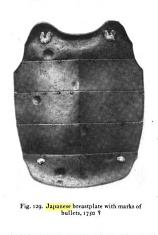
Plate armour is incredibly difficult to cut or puncture and, contrary to popular belief, very resistant to arrows. There was also a period after the advent of firearms when heavier plate was made bulletproof and shot after construction to provide a dent as proof of that fact.

Most, but not all, helmets use this manner of construction.

Mycenaean Dendra Panoply, bronze, 15th century BC


Bronze cuirass, Netherlands 11th to 8th century BC


Etruscan bronze breastplate, 8th century BC


Etruscan kardiophylax, bronze pectoral, 7th century BC

Greek bell cuirass, bronze, 7th century BC
Greek muscle cuirass 475 BC

Etruscan triple-disc breastplate, 5th-4th century BC
Carthaginian brass breastplate, 3rd century BC
Italian transitional armour, 14th century, incorporating elements of brigandine, mail and plate


Henry VIII's armour from about 1510, body armour does not improve after this point, Henry outgrows this armour fairly quickly


German anime cuirass from about 1590
A striking Cuirassier Officer's gold-painted three-quarter armour, Savoy, circa 1630. Comprising close helmet with rounded skull formed of two halves each with integral neck lame, the base studded with lining rivets on brass rosette washers, pivoted fall formed with hooded guards acutely arched over the eyes, visor cut with a single mouth-like breathe and the upper edges with hemispherical openings for the eyes, pivoted chinpiece:
French Cuirassiers three-quarter armour, 1630, the armour of the lower legs is discarded first

Persian krug mail and plate cuirass, 16th to 17th century
Japanese breastplate with marks of bullets, 1750
Iron plate cuirass from Nias, Indonesia late 19th to early 20th century